
2018’s Upgrade, directed by Leigh Whannell, managed to accomplish something that up until this point has been near-impossible on screens – create a good, low-budget, cyberpunk movie that manages to hold its own against its inspirations. Violent, pulpy, and often falling into tropes and clichés, Upgrade is by no means a perfect film, but the future-tech style of the movie oozes charm and excitement. Fans of the cyberpunk loved Upgrade – and why would they? The flaws are nothing that previous works haven’t tripped up on themselves, and the good parts seem to indicate a return-to-form for the semi-stagnant genre. Sure, there have been some great sci-fi films in the past decade that have claimed a place among genre greats like Bladerunner and The Matrix – Ex Machina and the sequel Bladerunner 2049 come to mind – but each of these films is missing a certain something that foundational cyberpunk had and used to great effect. Upgrade, despite its self-admitted B-movie qualities, is different. Cyberpunk fans will be happy to know that Upgrade follows in the footsteps of its early-eighties inspiration, namely including a healthy mix of both the signature, sci-fi grit as well as higher-concept stuff at the end.
Looking back to the stuff that made cyberpunk famous – Gibson’s Neuromancer, Otomo’s Akira, and Scott’s Bladerunner – a common thread between all these stories is a combination of the high and low sci-fi. Kaneda and Tetsuo are orphans in a gang, Deckard is a depressed cop working in urban slums, and Gibson’s Sprawl trilogy is full of body-mod junkies. Their lives, and the worlds they live in, frankly suck, and readers see the natural culmination of the exploitative, corporate-warfare dominated world that’s developing all around us. At the same time, though, these stories don’t stay down low, in the grittiness, but rather all juxtapose the brutality of the ‘real’ world with themes of transcendence or ‘transhumanism.’ We realize, as Deckard does, that maybe humanity isn’t a just biological thing. Akira’s Tetsuo is a street rat at the stories beginning, but by the climax, he’s reached a whole new level of existence. At the end of Neuromancer, the artificial intelligence’s have won and become more – offering this new state of existence to the main character, Chase, as well. Hopeful isn’t the right word for these endings, but they aren’t pessimistic either. Rather, these two seemingly incompatible ideas – the ‘high’ and ‘low’ sci-fi – came together in the original cyberpunk movement to create a sense of nihilistic catharsis – stories that make you feel extremely small, but not in a bad way.
And this is what a lot of modern-day attempts at cyberpunk are missing. We have films that are ‘future-noir,’ all about corporate warfare and body-modification, and we have films about AI, empathy, and asking questions about what is humanity. But none of these modern works, with few exceptions, have managed to combine the high and low themes that made early eighties cyberpunk movement the juggernaut it was.
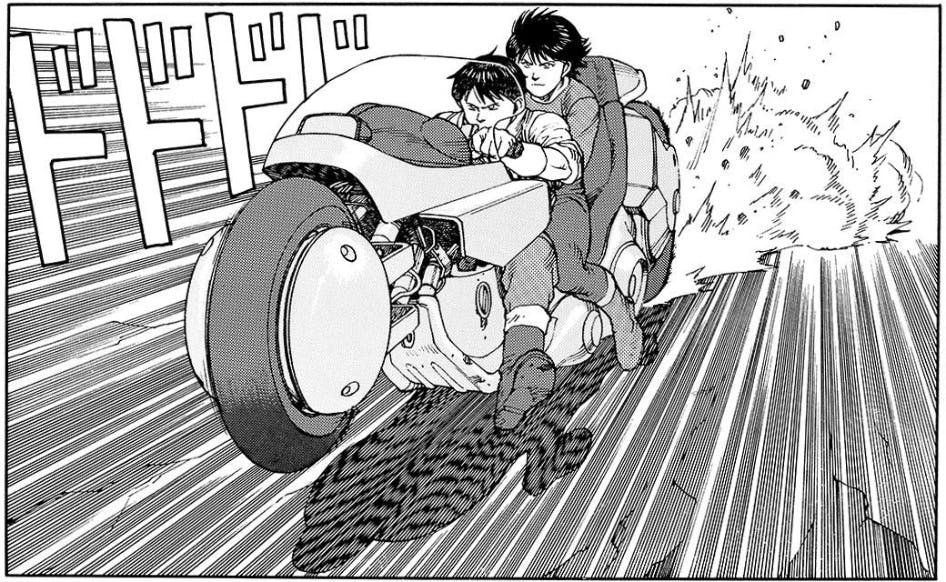
The kids in Akira live in a world in which they are essentially powerless. No wonder they turn to ‘crime,’ though they certainly don’t seem to think of their gang that way. In the semi-fascist, hugely-unequal police-state of Neo Tokyo, Kaneda and his friends’ biker gang seems like the natural course of rebellion, instead of wasting their time in institutions, like trade school, that offer them no escape. Both the manga and anime spend the majority of their length exploring this powerlessness and the brutal world which created it – and then, at the end, when Tetsuo does what he does, it hits even harder. The change from nobody to transcendence is what makes Akira’s climax work as well as it does.
A lot of modern-day sci-fi borrows some cyberpunk ideas and motifs while not fully committing to both of the key aspects. Spielberg’s Ready Player One (as well as the novel) and Obsidian’s 2019 RPG The Outer Worlds both play off the corporatized-future that early cyberpunk didn’t invent, but popularized. But while these all excel in their ‘low’ sci-fi ideas such as VR and a corporatized government, they lack any ‘so-what?’ moment that higher sci-fi themes could have provided. The result is that these stories feel almost lacking, especially when compared to other cyberpunk works. In the same way, both Her and Alex Garland’s Ex Machina are movies that explore transhumanism in a decidedly contemporary world. Both of these are still excellent sci-fi movies, but its interesting to think about where each of these films – and Ready Player One or The Outer Worlds – could have gone if they had attempted synthesizing the high and low sci-fi in true cyberpunk fashion.

Take a classic example of cyberpunk, Bladerunner, and compare it to a more modern movie with similar themes – Spike Jonze’s Her. Both deal with the humanity of Artificial Intelligence, as well as of people, but explore the ideas in very different ways. What Her lacks is the ‘low’ sci-fi – the grittiness. And while the world of Her is by no means the same as in Bladerunner, and the violence of the latter would be totally out of place in the former, I’d argue that a lack of the ‘low’ sci-fi hurts the film’s message. Exploring the nature of humanity through Deckard and his hunt to kill Artificial Intelligences is very different than looking at it through the lens of a man who has fallen in love with one. In Her, Samantha’s whole existence in the story serves to further the human character of Theodore. As opposed to Bladerunner, where the replicant characters act with their own agency, it seems as though Her has tamer ideas at heart about what makes something human. And, of course, both films have very different things to say and even more different ways of saying them, but in the case of Bladerunner, I’d argue the combination of the gritty hunter-hunted narrative with the transhuman ideas at the climax combine to a much stronger effect than those of Her.
That’s not to say that great cyberpunk – combining both aspects of the subgenre – isn’t made anymore, because it is. In addition to Upgrade, Netflix’s Altered Carbon, based on the famous book series, and the 2018 PS4 adventure game Detroit: Become Human come to mind. All three of these, and surely many more in the imaginative book and comic industries, are keeping the legacy of eighties cyberpunk alive, combining ‘future-noir’ and ‘transhuman’ to great effect. Videogames, in particular, have a lot of potential moving forward with the genre. CD Projekt Red’s Cyberpunk 2077 is shaping up to be one of the, if not the, biggest videogame releases of the decade. If the CDPR team can stick the landing and live up to the hype of their next huge RPG, cyberpunk as a genre could certainly be seeing a resurgence in the near future. Hopefully, as we move into the next decade – one that, interestingly, was the setting for a lot of eighties science fiction – authors, filmmakers, and all sorts of storytellers will be sure to learn a thing or two looking back to the foundational works of the subgenre when writing their own stories of the future.

 airquotes